Spleen and hypertension

Spleen and hypertension

The role of the spleen in hypertension

Arterial hypertension (AH) corresponds to an abnormal increase in blood pressure on the artery walls. It is also defined by figures measured by a blood pressure meter: from…

In Traditional Chinese Medicine (TCM), hypertension is not considered a pathology, but a syndrome that alerts us to a dysfunction of certain internal organs. TCM diagnosis identifies the energy imbalances underlying these dysfunctions. These vary naturally from one individual to another.

Hypertension according to TCM

Chinese medicine is always interested in the causes of so-called diseases, and never stops at the symptoms alone. The factors that can lead to hypertension are extremely varied. It is generally accepted that they are closely linked to a healthy lifestyle. Among these, the psycho-emotional aspect plays a vital and recognized role in hypertension.

Excessive anxiety related to the difficulties of daily life, constant stress, and underlying depression can lead to high blood pressure.

While each organ can play a role in the development of hypertension, particularly the liver and kidneys, we have chosen to focus here on the role of the spleen in high blood pressure through the production of Tán.

Spleen functions

The Spleen is a very important organ in TCM. It belongs to the Earth in the Five Elements theory, and is linked to the emotion of anxiety. It is at the center of the body and has the property of “bringing up” and “bringing down” the essences it extracts from food.

The Spleen transforms food and drink into blood and qi. It also plays a role in sorting and eliminating waste through stool, urine and perspiration.

A high-quality diet is therefore essential for the proper energy balance of the spleen. However, our diet is often too rich, and we eat too much.

What’s more, we consume foods that provide a lot of moisture (sugars, fats), or foods that are too raw or too cold. In both cases, we damage the spleen.

If the spleen is weak, its transformation and elimination properties will be disrupted. The spleen will not be able to eliminate all the waste from the digestive tract, which will then turn into Tán, or phlegm. The Tán formed can be either cold or hot in nature, depending on the individual.

This Tán will settle in the most vulnerable areas of the body, particularly on the walls of the blood vessels, thus hindering the free circulation of blood.

It is through Tán that the spleen is linked to blood pressure. Tán obstructs the blood vessels, making them harder and less elastic. This particularly affects the heart.

L'angélique chinoise, trésor de la mtc

Tán and digestion

This explains the importance of a properly functioning spleen. It plays a decisive role in the quality of digestion. Thus, the same meal eaten by several people will not be digested in the same way by each person, depending on the state of their spleen and, more generally, their yin/yang balance. If the spleen is functioning properly, it can assist in the elimination of excess food.

As the role of the spleen is to transform nutrients into Qi and Blood, it is important that food is easy to digest. This limits the risk of stagnation of poorly digested food, which can generate Tán.

Finally, if the spleen is functioning properly, Tán, even if it is produced, can be easily eliminated and will not be deposited in the blood. Thus, Tán is always related to poor digestion or overeating.

Preventing the formation of Tán

Tán is not only one of the causes of high blood pressure, but it can also lodge in other parts of the body, particularly the lungs. This can lead to coughing, bronchitis, or asthma. Tán can also block the flow of qi, causing stagnation, poor blood circulation, and pain. Finally, Tán can also disturb the mind and cause mental confusion, anxiety, and depression.

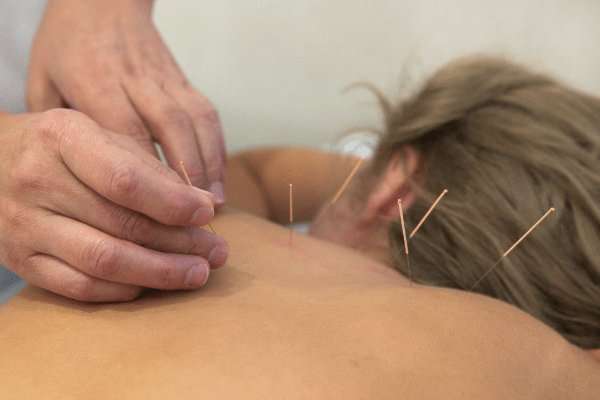
As we have seen here, it is essential to maintain the spleen, and all of the organs in general, in a good state of energetic balance. Chinese medicine can restore the necessary balance through acupuncture or herbal prescriptions. However, patients must also take action to rebalance their lifestyle, particularly their diet (see below). They must also take care to manage their emotions better.

Diet and Tán production

Taking care of your diet is the best way to avoid Tán production. Here are the main foods to avoid:

  1. fried foods (French fries, doughnuts and breaded foods) oily and fatty foods, which are difficult to digest;
  2. Sugar and sweet foods, including sugary drinks (sodas, sweetened fruit juices, energy drinks, etc.) and alcohol;
  3. Dairy products (especially full-fat cheeses, whole milk, cream and yoghurts). These are humidifying and can therefore encourage the production of mucus;
  4. Cold foods and drinks. Cold or iced drinks, or food taken out of the fridge too cold, weaken the spleen. The same is true of too much raw food;
  5. Refined and processed foods from the food industry.

Care should also be taken with the cooking method. Some cooking methods are conducive to the production of mucus or Tán, such as :

  1. Frying, which increases the fat content of food;
  2. Grilling and roasting at very high temperatures;
  3. Cooking with a lot of oil.

On the contrary, we recommend :

  • Light cooking, such as steaming, which preserves the nutritional value of food while facilitating digestion;
  • Boiled or braised foods;
  • Hot, cooked foods such as soups and broths, which support spleen function;
  • Steamed, lightly sautéed or boiled vegetables;
  • Whole grains (brown rice, quinoa, oats, etc.);
  • Lean proteins (fish, chicken, legumes)

Understanding pain

Understanding pain

Tòng and bì syndromes

Pain is the number one reason for consultation, accounting for almost two-thirds of all medical consultations, particularly in Europe. It is therefore an essential and delicate element in patient care.

Generally speaking, pain is something unpleasant that happens in the body. But it is also, at the same time, a personal and therefore subjective mental experience.

The International Association for the Study of Pain (IASP) describes pain as “an unpleasant sensory or emotional experience associated with present or potential tissue damage.”

This means that pain, in addition to indicating physical damage (potential or present), is, like its opposite, pleasure, a subjective emotional attitude, which triggers and shapes behavior. Pain is therefore neither a simple perception nor a purely physical sensation. It is fundamentally a mental state.

An energy block

According to traditional Chinese medicine (TCM), pain is generally a sign of energy blockage. However, this varies depending on the location of the pain and its causes. TCM classifies pain according to:

  • whether it is permanent or intermittent;
  • whether it corresponds to painful numbness with swelling in the joints;
  • whether it is due to excess pressure, spasms, radiation, etc.

The problem is complex. Pain is treated by unblocking the meridians, expelling excess fluids or mucus, and releasing blood stagnation.

For long-term pain, acupuncture and/or Chinese herbal medicine are used to reduce the level of pain and provide relief. Moxibustion, massage, and cupping are also widely used to relieve pain. Pain rarely occurs on its own; it is usually symptomatic of an energy imbalance that will be detected by diagnosis.

According to TCM, the concept of pain can be divided into two main syndromes: tòng (emptiness) or bì (blockages).

Bì syndrome

Bì are painful obstructions of the meridians caused by a combination of three perversions, also known as “the three demons”: Wind, Cold, and Dampness.

Bì syndrome affects the skin, muscles, vessels, tendons, bones, and meridians.

Poor lifestyle choices and bad social or eating habits can hinder the circulation of Blood and Qi in the meridians, thereby promoting the onset of Bi-type diseases.

These include:

  • irregular sleeping patterns,
  • overwork,
  • a cold or damp home, exposing you to Cold, Wind, and Dampness,
  • alcohol abuse,
  • an overly rich or insufficient diet,
  • excessive eating that damages Jing and Blood,
  • intense emotions experienced in excess (Anger, Joy, Emotional Shock, Worry, Sadness, Overthinking, Fear)
  • bruising or blood stagnation after external trauma.

Tòng syndrome

Tong syndrome, on the other hand, most often stems from internal causes.

It occurs in the Five Organs and Six Entrails. It is also found in the “particular Entrails”: Brain, Marrow, Bones, Vessels, Gallbladder and Uterus. Here, we often diagnose a Yin vacuum, a Yang vacuum, a Qi vacuum or a Blood vacuum (or a combination of all four).

The functions of the human body, whether organic or psychic, are linked together in perpetual motion. Any slowing down or blockage (痹 – bì) of movement in any of the body’s functions can lead to pain.

Pain is therefore a vast subject insofar as it covers multiple realities. We must therefore distinguish :

  • where it occurs (outside or inside the body),
  • its origin: external (meridians) or internal (organs [qìguān] and viscera [zāngfǔ]),
  • its type: emptiness or fullness,
  • its nature: acute or chronic, etc.

Here too, the list is long, and taking an anti-inflammatory won’t solve the root of the problem. It’s essential to see pain as an alarm bell that should draw our attention to a change in our lifestyle.

Painful periods

respiration profonde

Many women experience pain before and/or during menstruation. According to a 2005 study, 50-70% of teenage girls experience permanent or occasional dysmenorrhea. For 15-20% of them, this pain even forces them to limit their activity or even go to bed. Worse still, many women experience these pains as normal, almost inevitable.

But there’s nothing normal about pain. These pains are signs of energy imbalances, and most often of blood and energy stagnation in TCM terms. By restoring the flow of energy through acupuncture and/or pharmacopoeia, Chinese medicine can put an end to these pains.

This involves mobilizing qi and blood, nourishing blood and toning qi. A personalized diagnosis will enable each patient to be treated appropriately according to the nature of the imbalances observed.

Thanks to these treatments, women can finally experience their cycles in comfort and serenity.

Living wu wei

Living wu wei

The secrets of effortless action

The concept of Wu Wei ( 无为), as already mentioned in our previous article, translates as “non-action” or “effortless action”. Rooted in Taoism, wu wei is a veritable art of living. Understanding its value, and thus wishing to apply it to one’s own life, means gradually making changes in the way we live and view life. Here, we explore in greater detail how to access the magic of wu wei.

Questioning the way we live

Why should I question myself? Even though everything is going well in my life… I have a great job, I earn a lot of money, my children go to the best private schools… And yet!

I agree, at the moment I’m very tired; I wake up several times in the night to pee; in the morning when I wake up, I feel painful tensions and I’m not rested etc. These few discomforts are alerts that my body is sending me to let me know that I’m beginning to exceed my limits, or that there are hidden imbalances in my life. If I don’t pay attention, this can lead to much more serious problems or pathologies. It’s time to act!

Living with Wu Wei is a conscious approach in which we organize our lives to make room for the expression of our own nature, in harmony with the surrounding environment. Thus, Wu Wei asks us to discover who we really are, even before our bodies alert us.

Living wu wei therefore means listening to ourselves, hearing our needs, our regrets, our frustrations, and also what makes us tick. In this way, we learn to decode what makes us angry, sad, or anxious.

Conversely, we decipher the subtle things that contribute to our fulfillment and joy, the things that simply make us feel more alive. This discovery is an integral part of life and is akin to a journey of wisdom.

L'angélique chinoise, trésor de la mtc

Getting closer to nature

On this journey, getting closer to Nature is the most natural thing to do. From this will flow the rest of our evolution. As we’ve seen, Wu Wei means letting ourselves be carried along by the flow of nature, adapting to situations as water quietly penetrates the hardest rocks.

Be careful, it’s not a question of total abandonment, but of giving up on forcing things.

Getting closer to nature is a step-by-step process. The first step is to improve our lifestyle.

We’ll eat more and more fresh, local produce. We will take better care of our rest. We’ll spend more and more time in nature.

In this way, an increasingly intimate and trusting relationship is gradually established between us and Nature. We give our senses and our innate wisdom a chance to awaken.

Cultivating inner calm

Cultivating inner calm is already about distancing yourself from the difficulties you face. There are many practices (meditation, qi gong, tai chi, pranayama, martial arts) that help to develop this inner calm. All involve relaxation, inner listening and deep breathing. To penetrate the spirit of wu wei, we need to develop an ever finer attunement to our sensations and external stimuli. This enables us to reconnect with our intuition, our animal instinct.

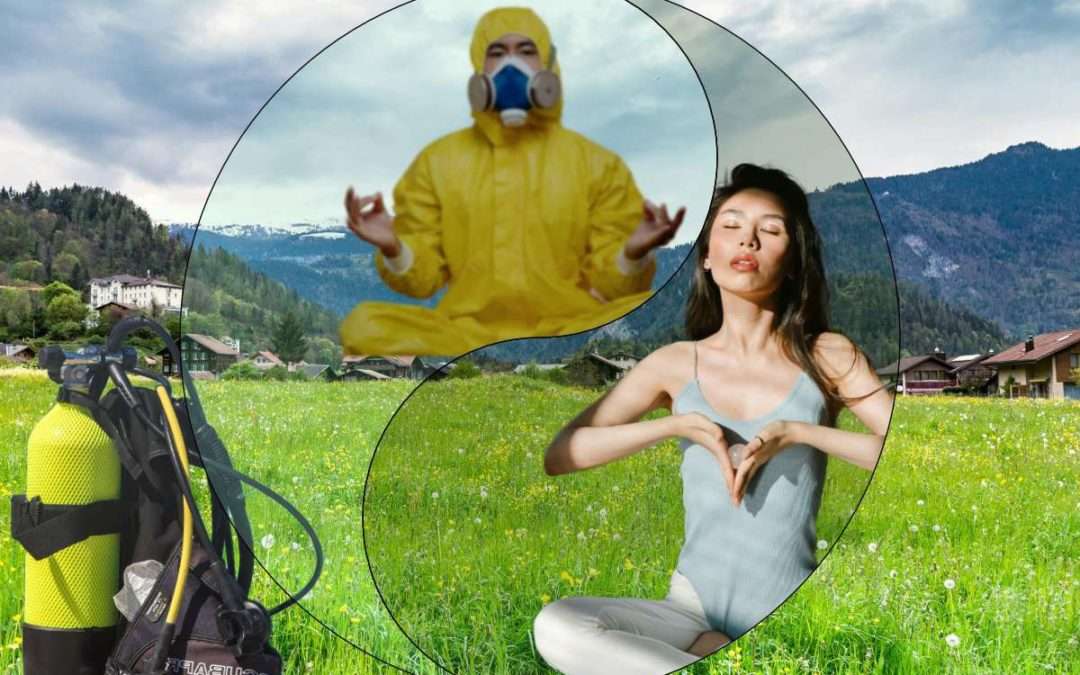
Flying, climbing, scuba diving, practising an art such as painting or music, or crafts such as pottery or woodworking also help to develop our five senses and our inner listening.

Faith in life

Living wu wei means having faith in life. It requires us to renounce the conditioning that limits us and drives us to fear. It invites us to develop a deep love of life in all its forms. To do this, we must relinquish control and let the universe organize the best solution for us to the various problems we encounter.

There’s no need for “I’ve got to…” or “I must…”. While it’s right to have a certain sense of responsibility, it’s also wrong to act solely out of duty, out of respect for social conventions, out of routine and so on.

Once we understand that most of the rules laid down by our societies, our governments and our parents are our prison, we take the first step towards non-action. To detach ourselves from social conditioning and be truly free takes time, perseverance and courage.

On this path, many give up for fear of losing friends, of being looked down upon by others…

But the further we go down this path, the more we discover its priceless benefits. The practice of non-action paradoxically enables our actions to become more efficient and constructive. We spend less useless energy, and are all the more available. Wu Wei gives us a feeling of relaxed awakening, an alert and peaceful attention that proves joyful and energizing. It awakens us to a form of wisdom. This makes it easier for us to allow ourselves to be carried along by the flow of life.

The creative process

Great artists live wu wei through their creations. Inspiration comes from their connection with the universal energy that animates all life, and their ability to surrender to it. Inspiration and the creative process have fascinated artists since the dawn of time. Picasso and Dali were filmed creating. Today, we organize happenings where we see an artist painting live.

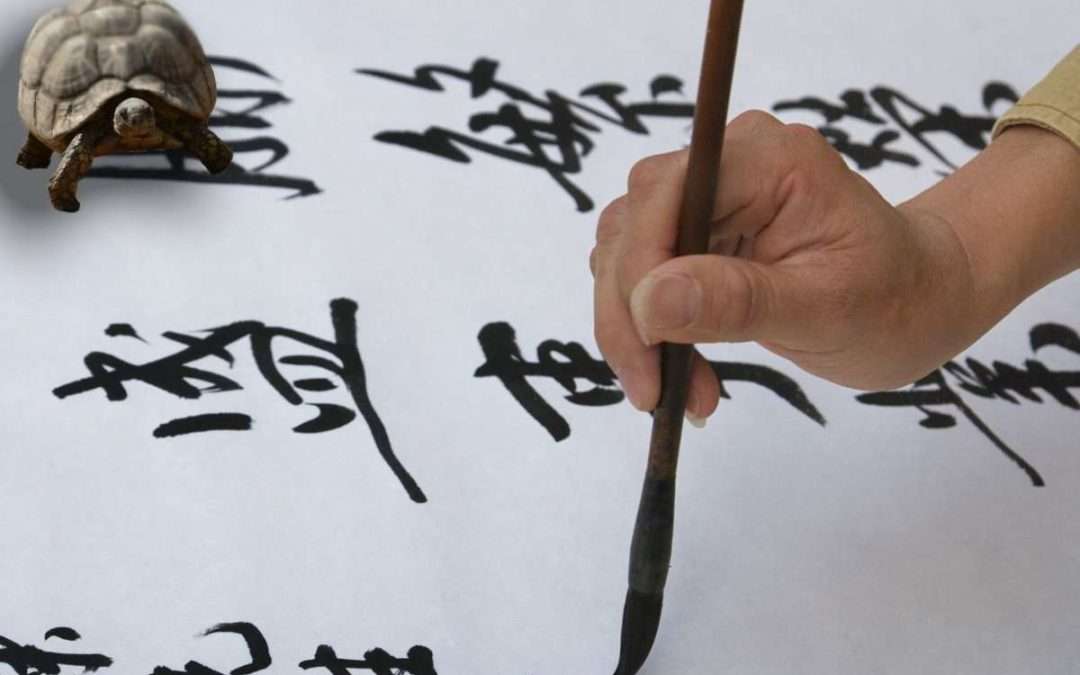
In ancient China, under the Tang dynasty, wu wei was a central element of artistic practice. The painter’s task is not to imitate the appearance of things, but to connect closely with the spirit of a mountain, a tree, a bird, and let that spirit flow through the brush onto the silk.

The act of painting is revered in itself. The poet Fu Zai describes a grand party organized to see the painter Zhang Zao at work thus:

“In the middle of the room, he sat down, legs apart, breathed deeply and his inspiration began to gush out. Those present were as frightened as if a bolt of lightning had flashed across the sky or a whirlwind had risen into the sky. Ink seemed to gush from his flying brush. He clapped his hands with a cracking sound. Suddenly, strange shapes appeared. When he had finished, there were pine trees, scaled and torn, precipitous cliffs, clear water and turbulent clouds. He threw down his brush, stood up and looked in all directions. It was as if the sky had cleared up after a storm, to reveal the true essence of tenmille choses. »

The large intestine

The large intestine

Elimination and letting go

In Chinese medicine, the large intestine (大肠 Dà cháng) is associated with the Metal element, the autumn season and the emotion of sadness. It is coupled with the Lung, yin organ of Metal.

The main function of the large intestine is to receive food ingested and transmitted by the small intestine. After absorbing part of the liquid, it excretes stool.

The Large Intestine, governed by Dryness, controls liquids. In other words, it absorbs the necessary quantity of liquids to ensure that it is neither too dry nor too moist. If it’s too dry, constipation ensues, and if it’s too wet, diarrhea.

Movement and routing

After receiving digested food from the small intestine, the large intestine transforms it into stool and ensures :

  • the stool circulates correctly,
  • that it is transported downwards.

In TCM, the Large Intestine is the minister in charge of circulation and transport. The movement of Qi from the large intestine is therefore clearly downward.

If this movement stops (stagnation), Qi then affects the Large Intestine and causes a disruption in downward movement. This then leads to abdominal distension and sometimes constipation.

Also, the Qi of the Spleen can collapse and then cause the collapse of the Qi of the Large Intestine, causing anal prolapse or blood in the stool.

It is the descending Qi of the Lung, the paired organ, that provides the Large Intestine with the Qi necessary for the effort required for defecation.

If the Lung Qi is insufficient, it cannot provide enough Qi to the Large Intestine for the function of defecation, resulting in constipation.

Conversely, if a person suffers from constipation, it can result in a disturbance of the descending function of the Lung, and therefore shortness of breath.

A waste disposal process

According to Chinese medicine, the organ pair Lung (yin) and Large Intestine (yang) is therefore associated with the autumn season and the emotion of sadness.

Autumn is the time when the energy cycle declines, and tree leaves fall and die. They are then decomposed by the rains. This process of death is essential, as it enables other forms of life to develop next spring.

This same process is at work in the human body. The large intestine helps us get rid of the old, of what we no longer need. This process involves eliminating not only waste from the digestive process, but also our mental and spiritual waste. After enjoying the harvest in body, mind and spirit, we must let go to make room for other life forms, for evolution.

Metal imbalances

Metal element disorders often affect the skin. Like the lungs, the skin is the only part of the body in direct contact with the outside air (the skin “breathes”). Like the large intestine, it eliminates toxins through perspiration. People with a Metal imbalance often have a history of dermatological problems: eczema, psoriasis, dermatitis, acne, etc. Or, more subtly, a history of skin problems. 

Lung and large intestine have an impact on the quality of our skin and our state of mind. According to Traditional Chinese Medicine, Metal, by extension, nourishes the skin, the throat, the sense of smell and the power of our voice.

The large intestine eliminates and evacuates the body’s waste products. Problems related to the large intestine are a sign of our fear of missing out, of making mistakes, of letting go.

Difficulties in letting go

If our Metal energy is weak, then our ability to let go will be unbalanced. Either we let go of things too soon, or we hold on to them for too long.

When a loved one dies, for example, it is normal to feel grief, which is a Metal emotion. If this loss does not affect us at all, or if, on the contrary, the sadness we feel lasts for years, this indicates that the Metal element is out of balance.

When we really can’t let go, every event, no matter how small, affects us greatly. We move forward in life looking back at the past.

A balanced Metal element creates in the individual an awareness of the divine spark within them. If this divine spark within us is cut off, it can lead to absolute resignation.

Nothing and no-one has any meaning or value. The individual sees no point in taking care of himself, let alone others. He’s always negative about everything he does, and falls into depression.

Others will try to compensate for this emptiness by displaying a perfect appearance. We’ll see people who take care of every detail of their appearance as well as their living space. In their home, everything is in its place, no thread sticking out, no wisp of dust making an appearance. They will seek to accumulate wealth and flaunt it in broad daylight in an attempt to create that impression of value through the eyes of others.

Rebalancing metal energy

respiration profonde

As we’ve seen, it’s important not to repress sadness, nor to cultivate it. Meditation and deep breathing can help us learn to accept our emotions without letting them overwhelm us. Keeping a diary can also help you let go of certain emotions.

This is particularly important in the case of sadness, which is linked to the lung and large intestine. Breathing deeply, consciously and for a long time can help cleanse any grief or sadness you may be holding inside.

Autumn, the season associated with metal, is the time to focus on root vegetables. It is advisable to slightly increase consumption of foods with an acidic taste, such as sourdough bread, lemons and limes, grapefruit, pickled and fermented foods, leeks, azuki beans, vinegar, rosehip tea, yoghurt, etc. White foods, such as onions, garlic, turnips, radishes, daikon, cabbage, pears, etc., are traditionally considered lung-protective.

People suffering from dryness (dry cough, dry throat, dry skin, etc.) may wish to consume moister foods, such as tofu, tempeh, spinach, barley, millet, pear, apple, persimmon, seaweed, almonds, pine nuts, sesame seeds.

Wu Wei, the magic of non-action

Wu Wei, the magic of non-action

A highly instructive Taoist concept

Wu Wei ( 无为) is a Taoist concept commonly translated as “non-action” or “effortless action”. It designates an attitude to life that consists of acting in harmony with the movement of Nature and its laws. Lao Tzu (see box) made it a principle of ideal government, and several Chinese emperors had their thrones inscribed with “wuwei” on a lacquer panel.

This principle is particularly interesting to explore at a time when Man is living against the natural flow of life, seeking to own, plan and control everything, including nature. With wu wei, it’s all about surrendering to the flow of life, letting it flow through us and guide us. This does not mean passivity, but rather the right and appropriate action.

Our lives are increasingly disconnected from nature and its rhythms. Social conditioning values overactivity, competition, speed of execution and “always more”. From an early age, we are programmed to please our parents, to succeed, to conform to social rules, and thus to meet external expectations. To such an extent that we lose touch with who we are and what our deepest aspirations are. Most of the time, we act out of duty, not out of a vital impulse. We prefer “DOING” to “BEING”.

Rediscovering harmony with nature

Swiss adventurer Sarah Marquis has devoted her life to blending in with nature, traversing the most hostile lands with no food reserves or villages in her path. There she survived hunger and thirst, awakening the fabulous resources that each of us possesses deep down inside, the so-called animal instinct. She explains how, after spending some time away from “civilization”, she can sense the presence of water 5 km away!

Of course, life on earth requires a certain number of actions to maintain life: feeding ourselves, learning, taking care of our health, our children… But these tasks should be carried out in a way that contributes to our fulfillment, and not reduce us to a state of virtual slavery.

The Yang Sheng principles of Chinese medicine point in the same direction: the more we live in harmony with nature and with our own nature, the healthier we are.

Practising Wu Wei means accepting to let life work through us. This state of availability is characterized by an absence of effort, an ease that allows the right action to take place at the right time and in the right way.

It requires trust in life, in the intelligence at work within and around us, which the Chinese call the Tao.

Letting go of our conditionings and beliefs

This means letting go of our social conditioning and beliefs, and responding more spontaneously and intuitively to events, like a toddler who hasn’t yet been shaped by school and society. It also means putting aside our egotistical goals and desires, as well as countless social pressures.

Practising Wu wei means returning to a simpler life, reconnecting with our complete being, both material and spiritual. To do this, we have to give up certain aspects of our lives that are a source of stress, resistance and suffering.

Everyone has experienced this characteristic Wu Wei state at least once in their life. He/she has experienced that state of grace where events follow one another as if by magic, and we achieve unexpected results without having done anything special. Sometimes it can even seem like a miracle.

Flow or the magic of wuwei

Top-level athletes are familiar with this state of optimal functioning. They seek this state, which they call the flow or the zone.

“In a state of flow, athletes seem to be able to perform at their best in extremely favorable conditions, combining, for example, concentration, automatic movements, enjoyment, and a sense of balance between the challenge and their abilities,” explains researcher and author Jackson.

This is also the case for artists and scientific geniuses, who in moments of inspiration receive musical notes, words, recipes… even mathematical equations. They are then in a state of openness and connection with Nature and its intelligence, which allows it to penetrate them.

But experiencing Wu Wei in this way, from time to time, does not mean living in the spirit of Wu Wei. Living Non-action is a philosophy of life; it involves questioning our priorities and gradually transforming our state of being. In the second part, we will see which paths and practices can bring us closer to this state of Wu Wei.

For this state provides an incredibly pleasant sensation that makes our lives more beautiful and our actions more effective. It’s the perfect way to embellish our lives and those around us. Indeed, by connecting deeply with nature, we naturally respect all life around us.

Lao Tseu, the father of wuwei


According to Chinese tradition, Li Eul or Lao Tan, better known as Lao-tseu or Laozi (Old Master), lived in the 6th century B.C. He is considered the father of Taoism, and is one of the mythical figures of ancient China, like Confucius.

His life has given rise to many legends: after a miraculous birth, he is said to have lived for two hundred years, and to have given some teachings to the young Confucius. He was archivist and astrologer to the Zhou emperors. He then fled westwards, disgusted by the decadence of this dynasty. Before crossing the border into India, he is said to have entrusted the guard with his philosophical testament, the Tao-tö king (or “Book of the Way and Virtue”), a major Taoist text. We don’t know how he died.

Lao-tseu is considered by Taoists to be a god (太上老君, Tàishàng lǎojūn, “Supreme Lord Lao”) and their common ancestor. He is depicted as a white-bearded old man, sometimes riding a buffalo.

The tao aims to purify man and lead him to the right path and virtue. One of Lao Tzu’s main doctrines is that of non-action, which should encourage people not to expend energy unnecessarily, and to detach themselves from cumbersome desires. Taoist thought proposes meditation as a condition for opening up to the world.