



Acupoints to calm the Shen
The term “ghost points” (or Guǐ points, from the Chinese 鬼) originates from the clinical perspective of traditional Chinese medicine (TCM). This ancient term refers to acupuncture points with a strong psycho-emotional effect. They are thus capable of soothing whatever is troubling a person from within.
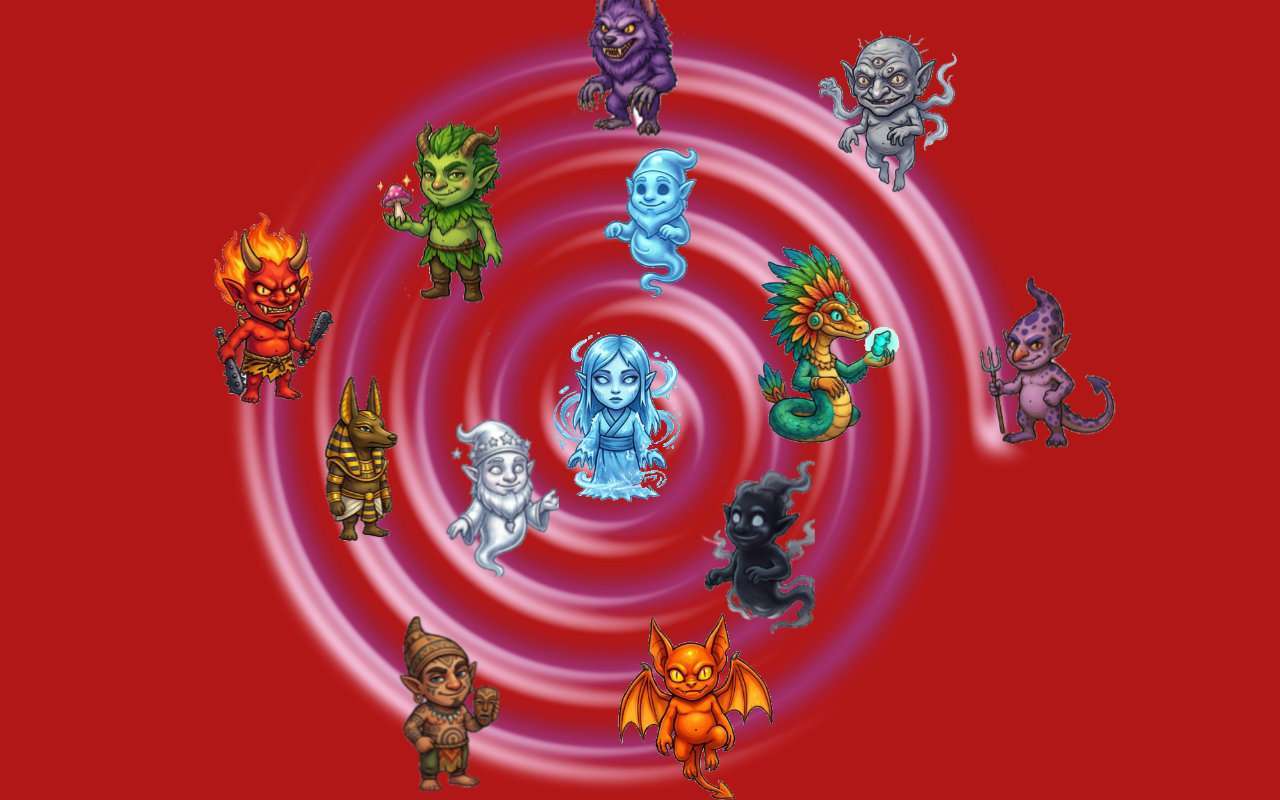
In the early days of Chinese medicine, the physician was a shaman (the Wū, 巫). He served as an intermediary between the visible and invisible worlds. In this shamanic view, acute mental illness (dementia, epilepsy, hysteria, loss of consciousness) meant that the person’s soul (Hún or Pò) had been stolen, fractured, or invaded by the energies of the dead or wandering entities, the Guǐ (see box).
Thus, in a reconnection ritual, the shaman-healer restored order to the patient’s inner cosmos. Needling these thirteen specific points involved placing “sentinels” at the body’s boundaries. These sentinels signaled to the disruptive energies that they were no longer permitted to remain there.
These points are therefore keys to emergency intervention and the profound restructuring of the psyche.
The Historical and shamanic origins
Long before the meridians were formally defined, illness was often attributed to invisible forces or the influence of evil spirits (the Guǐ) that came to disturb human beings.
In the 7th century, the Taoist physician Sūn Sīmiǎo compiled a famous list of 13 acupuncture points, known as the “ghost points.” He compiled existing medical knowledge and assigned each of these points a secondary name containing the word Guǐ.
These points are ordinary meridian points that thus serve additional functions. Their secondary names reflect their particular significance when the Shén—the spirit—is severely disturbed.
The meaning of the word Guǐ (鬼)
The term Guǐ does not necessarily refer to demons or ghosts in the sense of evil spirits, but rather:
- Mental agitation: in Chinese medicine, Guǐ describes that which wanders, is devious, or disturbs the Shén (a person’s spirit or mind);
- That which displaces calm: this includes obsessive thoughts, acute anxiety, perceptual distortions, or uncontrolled behavior.
Clinical Interpretation

Today, practitioners interpret these conditions through the lens of Chinese medicine physiology. Severe agitation, confusion, seizures, or profound shock often correspond to phlegm (tán) that obscures the Heart’s orifices.
In Chinese medicine, phlegm is not merely what one coughs up. It is a thick substance produced by a Spleen (pí) exhausted by worry. When this phlegm rises, the Shén no longer has a clear space. The Heart (xīn) becomes agitated. Sleep may be disrupted. This aligns with what we observe in prolonged anxiety and severe sleep disorders. Internal wind (nèifēng) may also arise and exacerbate the confusion.
Points such as 26 VG (Rénzhōng) or 7 MC (Dàlíng) then help to clarify the mind, restore presence, and soothe the patient after severe emotional shocks.
The Guǐ points therefore serve to reopen a passageway when agitation is intense. They help the practitioner restore calm.
In practice, they are useful when patterns repeat themselves: past traumas, obsessions, and emotional loops in which a person becomes stuck. They help to get a stagnant breath flowing again.
They can also help when the body seems unresponsive to standard treatments. By opening the Heart orifices, they allow Qi to flow again.
Practical uses
For practitioners, the Guǐ points are major energy gates. These 13 points can be used as a whole; however, most practitioners today use between 2 and 5 of them, depending on their diagnosis. The Qiánjīn Yàofāng recommended starting with Guǐ Gōng (Rénzhōng), then continuing with Guǐ Xīn, Guǐ Lěi, Guǐ Xīn, and so on. It also specified that it was “not necessary to needle all of them; stopping at five or six is sufficient.”
Thus, the order of the points is that of the complete method; it is not an absolute rule when only a few points are selected. Traditionally, the practitioner uses their own concentration and breathing, in addition to needling, to guide the movement of Qì around these points.
Unresolved emotions stagnate in the form of blockages. The “demon” points act as outlets: they open a passage to allow what is corrupted to be expelled, while restoring the free flow of Qì. In certain contexts, particularly after a shock, points such as 16 VG (Fēng Fǔ) are used to restore presence and treat the internal wind associated with the impact.
A holistic Medicine
These Ghost points underscore the importance of the holistic dimension of TCM. Indeed, patient care must take into account all aspects of the patient’s being and history. It cannot overlook either the patient’s emotions or disturbances arising from the patient’s climatic, energetic, or relational environment.
The thirteen fortresses of Shen
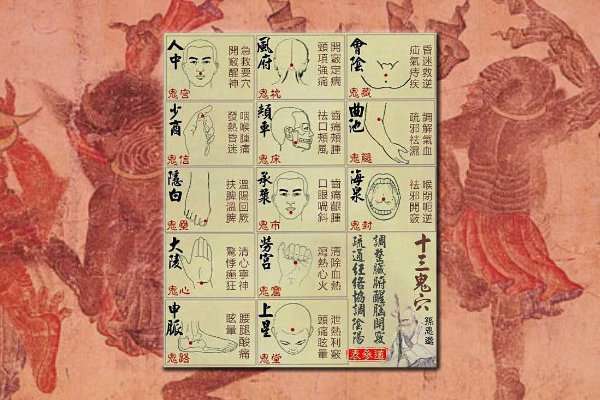
In medieval China during the Tang Dynasty, raving madness, night terrors, and sudden lapses in consciousness were understood as the intrusion of a Guǐ (鬼). Far from being an abstraction, the Guǐ referred to a residual Yin breath—an earthly soul (Pò) severed from the cycle of the ancestors, wandering without a burial or offerings. When a man’s righteous breath (Zhèngqì) weakened, this parasitic influence would rush into the cracks of his flesh. It would take up residence in the imperial abode of the being: the heart, where the Shén (the Spirit) resides.
Faced with these cases of possession and delusional rages (Diān Kuáng), the great Taoist physician Sun Simiao (7th century) recorded an exceptional strategy in his treatise Bèi Jí Qiānjīn Yàofāng: the thirteen ghost points (Shísān Guǐ Xué). Unlike the rituals of folk shamans (Wū), this method integrated exorcism with the rigor of medical science.
A military strategy
The doctor never pricked at random: he conducted a methodical assault. Respecting cosmic polarity—the left side first for men (Yang), the right side for women (Yin)—he followed a military strategy. He began at the “Palace of the Demon ” (Guǐ Gōng, under the nose) to revive the facial orifices. He then secured the “Faith of the Demon” (Guǐ Xìn, at the thumb) and the “Fortress of the Demon” (Guǐ Lěi, at the big toe). Each needle placed a territorial lock: the body once again became an orderly fortress. Thus, the perverse breath no longer had a foothold.
The techniques alternated depending on the nature of the barriers. Some points received the fire needle (Huǒzhēn), red-hot from the flame to dispel the spectral cold; others were incised to bleed out the toxic heat; finally, the “Demon’s Storehouse ” (Guǐ Cáng, at the perineum) required the gentle heat of moxibustion. As the needle progressed toward the root of the tongue (Guǐ Fēng, the “Seal of the Demon”), tradition even required the practitioner to question the spirit, demanding its name and its departure.
This protocol illustrates the coherence of a world where the physical, the ritual, and the invisible were one and the same. For Sun Simiao, curing delirium was not merely a matter of treating symptoms. It was a matter of restoring the sovereignty of the Shén by reassigning every breath—whether living or deceased—to the exact place it was meant to occupy under Heaven.
0 Comments