






Eight key points to begin the diagnosis
Diagnosis in Chinese medicine is a subtle art that relies on multiple tools, including the renowned pulse diagnosis. Before any treatment, the Chinese physician must observe and listen to understand the nature of the patient’s energetic imbalance. To guide this process, they have a valuable tool called the Bā Gāng, or the “Eight Principles of Diagnosis.”
The Bā Gāng provides a treatment direction in just a few minutes of observation. This is why, centuries after its formulation, it remains a key entry point to diagnosis. Anyone curious about Chinese medicine will also benefit from understanding its essence.
The Bā Gāng describes a configuration of Qi (the vital energy that animates and flows through the body) for an individual at a given moment.
Four pairs of reference points
It proposes four pairs of reference points:
- Yin and Yang.
Yin is the inner pole, cold, calm, and nourishing, and Yang is the outer pole, hot, active, and mobile.
- Biao and Li
Biao is what is outside the body, therefore on the surface, and Li is what is inside, including the organs.
- Han and Re
Han expresses a rather cold nature, and Re expresses a rather hot nature.
- Xū and Shi
Xū signifies emptiness or deficiency, and Shi signifies fullness or excess.
Each of these pairs addresses a facet of energetic imbalance. Their combination forms a quick and effective framework for guiding treatment.
The Origins of Bā Gāng
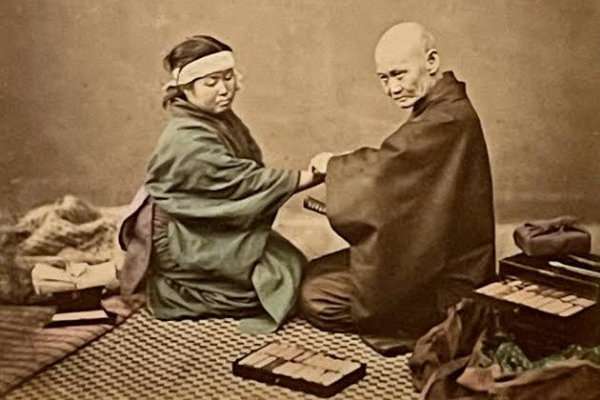
The Huangdi Neijing, or Yellow Emperor’s Inner Classic, is one of the foundational texts of Chinese medicine. It already establishes the Yin/Yang distinction as a prerequisite for any diagnosis. The skilled practitioner begins by observing the complexion and palpating the pulse, then distinguishes Yin from Yang before anything else.
During the Ming dynasty, the physician Zhang Jingyue further developed this concept in his Lei Jing. This extensive treatise classifies and comments on ancient medical knowledge. He emphasizes that healing begins with distinguishing between Yin and Yang.
Finally, the Cultural Dissemination Center of the Beijing University of Traditional Chinese Medicine reminds us that this hierarchy remains. Yin and Yang continue to be the overarching reference point, the one that encompasses the other six. It was only later, with the formalization of modern diagnostic manuals, that the Bā Gāng became the autonomous and structured chapter it is today.
Yin and Yang: the encompassing pair
Why always begin with the Yin-Yang pair? Because it prevents the practitioner from getting lost in the details before grasping the essentials. Yin and Yang, in fact, encompass the other six principles.
Thus, any manifestation of Biǎo, Rè, or Shí naturally falls under the Yang category.
And any manifestation of Lǐ, Hán, or Xū falls under the Yin category.
This division provides the general direction of the treatment even before delving into the details. A Yang pattern calls for dispersing, cooling, and circulating. A Yin pattern calls for tonifying, warming, and nourishing.
When faced with an agitated patient, flushed and speaking loudly, the Yang approach should prevail. When faced with a prostrate, pale patient with a weak voice, the Yin approach should take precedence. This immediate reading, which becomes instinctive with practice, prepares the ground for the three other, more precise pairs.
Biǎo and Lǐ: locating the damage
Once the general direction given by Yin and Yang is established, a common-sense question arises: Is the imbalance recent, or has it been brewing for a long time?
This is precisely what the pair Biǎo and Lǐ helps to determine.
- Biǎo refers to the exterior, the surface, the skin, the superficial muscles, and the meridians.
- Lǐ refers to the interior, the organs, the blood, and the deep fluids.
This pair answers a simple question: where is the struggle between Zheng Qi (the body’s own energy) and Xié Qi (the pathogenic energy that attacks it) located?
A Biǎo syndrome often suggests a recent attack: Xié Qi (邪氣), a pathogenic factor related to climate, for example, has just invaded the body’s surface. This engages Zheng Qi (正氣), the body’s own vital force, in a struggle to maintain health. This situation (wind, cold, heat, humidity…) is disruptive and threatens the body’s balance. These climatic disturbances, by definition, come from the outside.
Conversely, imbalances arising from a prolonged internal cause (stagnation, emotional excesses, poor diet) fall under the category of Lǐ.
The more superficially the imbalance is detected, the easier it is to treat.
Clinical signs of Biǎo syndrome include an aversion to wind or cold, a slight fever, a fluctuating pulse, and a relatively unchanged tongue.
Lǐ syndrome is more deeply and persistently established. It can manifest as marked digestive problems, and altered urine and stools. The pulse is deep, and the tongue coating is thick.
Between these two extremes, clinical presentations often show mixed patterns, where the pathogenic factor migrates from the surface to the interior if the Zhèng Qì (Correct Qi) weakens. Therefore, recognizing this shift is the first step in acting promptly, rather than reacting to an established imbalance.

Han and Re: the nature of the imbalance
After the “where,” the “how” naturally follows. What is the nature of this imbalance?
Hán, meaning cold, and Rè, meaning heat, describe the thermal nature of the disorder, whether it originates externally or stems from a prolonged internal imbalance.
- A Hán syndrome manifests as chills, cold extremities, clear and abundant urine, and loose stools. It is also accompanied by a pale tongue with a white coating and a slow pulse. These marked digestive and urinary symptoms primarily characterize a Lǐ Hán, a coldness that has taken root internally. A recent external condition is often limited to chills and cold extremities, without these profound digestive disturbances.
- A Rè syndrome, on the other hand, manifests as a sensation of heat, thirst, dark and infrequent urine, and constipation. It is accompanied by a red tongue with a yellow coating and a rapid pulse. These pronounced signs (intense thirst, dark urine, constipation) are primarily indicative of Lǐ Rè, a deeply entrenched heat. Recent external heat is more likely to manifest as fever and moderate thirst.
Xū and Shí: the force at play
One final, crucial question remains: does the body still have the strength to defend itself, or must it be supported first?
Xū, the deficiency of energy, and Shí, the excess of energy, indicate which of the two dominates in the patient: Zhèng Qì, the body’s own energy, or Xié Qì, the pathogenic factor.
- A Xū syndrome indicates a deficiency:
Zhèng Qì is weakened, the symptoms are subtle, the voice weak. The pulse is thin and weak, the tongue often pale and swollen.
- Conversely, a Shí syndrome indicates an excess:
Xé Qì is abundant and aggressive, the symptoms are pronounced, the voice loud. The pulse is full, the tongue firm.
Cross the eight markers
In practice, these four pairs are never observed in isolation.
For a single patient, the practitioner combines the four responses obtained to create a complete picture, rather than four separate readings.
Chronic fatigue with chills and slow digestion will thus yield, in a single patient, the combination Lǐ, Hán, Xū. This indicates an internal, cold, and deficiency-type condition.
The onset of a febrile flu will yield, in another patient, the combination Biǎo, Rè, Shí: an external, hot, and fullness-type syndrome.
The practitioner’s task is to assemble the four pairs specific to each patient to establish a complete differential diagnosis. This will, of course, be based on other examinations: patient history, pulse diagnosis, tongue examination, etc., to validate and refine the diagnosis.
When reference points become blurred

In reality, these markers are often not so clear-cut. This is what makes the method so fascinating to explore further. In Chinese diagnostic manuals, two concepts add nuance to the elegant symmetry of the Bā Gāng. These are Xiāng Jiān, or combination, and Zhuǎnhuà, or transformation.
Combination describes patterns where several markers, from different pairs, appear together in the same patient, each providing distinct and complementary information. A Biǎo Hán Shí, cold and full exterior, or a Lǐ Xū Rè, empty and hot interior, are classic examples.
Transformation, on the other hand, describes the shift from a marker to its opposite as the disorder evolves.
A poorly treated Biǎo syndrome can migrate inward and become Lǐ. A prolonged excess can deplete the Zhèng Qì and lead to emptiness. Stagnant cold can generate secondary heat.
These shifts require the practitioner to reassess their diagnosis at each consultation, without remaining fixed on the initial interpretation. A patient seen on the third day of their flu is no longer the same as on the first day. This is true even if the illness still has the same name. Thus, the Chinese practitioner will update their diagnosis as the treatment progresses and the patient’s condition evolves.
0 Comments