

Mitochondria
Our living powerhouses
Imagine a city at night, lit by a thousand lights. For everything to work, electricity is needed everywhere and continuously. Our body works exactly like this.
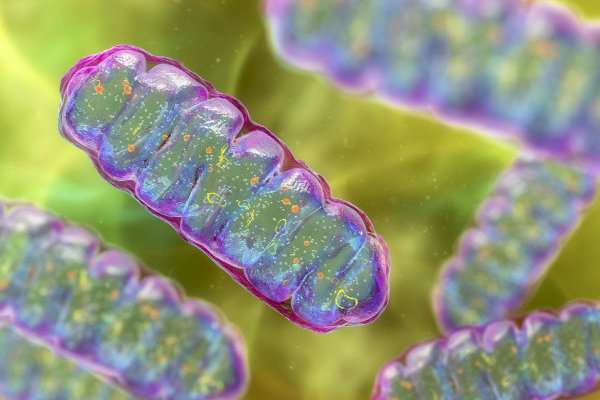
Each cell is home to hundreds, sometimes thousands, of tiny structures called mitochondria. They are veritable miniature power plants, invisible to the naked eye but essential to life.
Their job is to transform the oxygen we breathe and the nutrients from our meal into an energy storage molecule: ATP (adenosine triphosphate). This molecule powers absolutely everything: from the beating of the heart to the most fleeting thought, including the contraction of a muscle or the healing of a wound.
The cells that consume the most energy contain the greatest number. A heart muscle cell can thus contain several thousand mitochondria, sometimes occupying up to a third of its total volume. A less active skin cell nevertheless has a few hundred. This distribution follows a simple logic: the more intense the energy need, the more numerous and efficient the power plants must be.
But before understanding how they work, let’s go back to their strange origin.
Bacteria become allies
Here is a fact that often surprises: mitochondria are not born with our cells. In fact, they have a completely independent origin, almost foreign to our body.
About two billion years ago, a bacteria capable of using oxygen was taken up by a larger cell. Rather than being digested, it settled permanently inside, in an exchange of good processes: the host offered shelter and food, the bacteria provided much more abundant energy thanks to oxygen.
This marriage of circumstance — which scientists call endosymbiosis — gave rise to all the complex cells that make up plants, animals and humans today.
The most disturbing evidence in this story? Mitochondria still have their own DNA, distinct from that housed in the nucleus of the cell. This mitochondrial DNA is transmitted almost exclusively by the mother, from generation to generation, without ever mixing with that of the father. Thus, each of us carries within us a direct genetic trace of our maternal lineage.
This bacterial origin explains why the role of the mitochondria today goes far beyond the simple production of energy.
Recent scientific discoveries
For a long time, biology summarized the mitochondria as a simple “ATP factory”. But the last two decades have completely changed our outlook. We now know that she is a true conductor of a cellular orchestra:
- A stress sensor and an alert signal: The mitochondria detects attacks (infections, metabolic overloads, toxins) and sends alert signals to the rest of the cell to adjust its response.
- The arbiter of life and death (apoptosis): It orchestrates the programmed destruction of worn out or abnormal cells. Without this cleaning, faulty cells accumulate, promoting serious disorders such as the development of tumors.
- Cellular dialogue (mitokines): Recent research shows that mitochondria emit small messenger molecules — mitokines — which inform the entire organism (brain, muscles, liver) about their level of energy stress.
-
The transfer of mitochondria between cells: Recently discovered, the phenomenon of mitochondrial transfer shows that a cell in difficulty can receive healthy mitochondria transmitted directly by neighboring cells (in particular stem cells) via microscopic channels. A gesture of cellular solidarity essential for tissue repair.
This is why mitochondrial decline is directly associated with chronic fatigue, neurodegenerative diseases, metabolic disorders and the aging process. Over the years, the performance and number of mitochondria decrease. But this decline is not an inevitable fate: mitochondrial renewal directly depends on our lifestyles.
The principle of hormesis
Producing energy naturally generates reactive compounds: reactive oxygen species (ROS) or free radicals. They are often compared to the “smoke” produced by a power plant.
In moderate quantities, these compounds are not simple waste: they act as essential signal foams. In biology, this phenomenon is called hormesis: a slight temporary stress stimulates the cell’s defenses and triggers the creation of new mitochondria (biogenesis), making the organism stronger.
It is chronic overload that becomes toxic:
Overeating and refined sugar saturate the cell with fuel, causing continuous oxidative stress that the body is no longer able to purify.
Being sedentary signals to the cell that it no longer needs energy. Through a process called mitophagy, the body eliminates unused material, reducing the mitochondrial network.
Chronic stress and lack of sleep consume ATP without regeneration, depleting the cell.
Environmental pollutants directly degrade key enzymes in the energy network.
The challenge is therefore not to protect the mitochondria from any effort, but on the contrary to provide it with the right adaptive stresses to stimulate its plasticity and renewal. Indeed, mitochondria renew themselves, multiply and become more efficient throughout life, provided they are given the opportunity (see box).
Modern science and ancient wisdom
It is fascinating to note that ancestral medical traditions already described this dynamic. Traditional Chinese Medicine (TCM) has spoken for millennia of Qì (vital energy drawn from the air and food), Jīng (the deep reserve of energy received at birth) or Yang Sheng (“the art of nourishing life”).
Today, biology offers molecular insight into this clinical intuition. The mechanisms of ATP, mitochondrial biogenesis and autophagy provide a biological basis for the energetic principles observed for millennia by Chinese Medicine.
Stimulate mitochondrial plasticity

Here are some effective techniques — from neuroscience, sport and holistic traditions — to activate this great energetic renewal.
1. Physical training
-
- Mechanism: Intense effort creates a sudden need for energy which forces the cell out of its comfort zone. In response, the body orders the production of new mitochondria to become more resistant.
- In practice: Alternate 1 to 2 weekly high-intensity sessions (e.g. sprints, dynamic cycling) with moderate fundamental endurance work (Zone 2: brisk walking, light running, swimming).
2. Apnea and work of breathing
-
- Mechanism: The temporary reduction in oxygen supply sends a strong adaptation signal to the cell. To function with fewer resources, it forces its mitochondria to become more efficient and accelerates the recycling of aging structures.
- In practice: Guided empty lung retentions, gentle apnea exercises or 5 to 10 minutes per day of rhythmic breathing (always practice in a calm and safe place, never in water).
3. Qi Gong, Tai Chi and Slow Breathing
-
- Mechanism: Unlike strenuous exercise which creates direct metabolic stress, the internal arts calm the nervous system. By lowering stress hormones (like cortisol), they protect mitochondria from premature wear and exhaustion.
- In practice: Slow movements and regular diaphragmatic breathing to reduce the daily aggression of chronic stress.
4. Intermittent fasting
- Mechanism: Temporarily deprived of sugar, the cells switch to fat metabolism. This change of fuel triggers a major automatic cleaning (mitophagy): the cell eliminates its tired components to make way for new material.
- In practice: Respect a digestive rest window of 14 to 16 hours (e.g. light dinner around 7:30 p.m. and next meal at 11:30 a.m./noon), 2 to 4 times per week.
-