


The art of arranging your home to make it healthier
In a home, light comes in, air circulates, and dampness sometimes lingers. For Traditional Chinese Medicine (TCM), whatever passes through a place also passes through the people who live there. A lingering cough or a heavy head on waking, for example, can have their origin in our home. The Taoist tradition gave rise to feng shui, the Chinese art of arranging spaces. Among other things, this ancient art takes into account the impact of our home’s layout on our health.
How place influences health
Chinese medicine also takes the patient’s environment into account. The Sù Wèn, the first book of the Yellow Emperor’s Inner Classic, explains why the same illness is treated differently from one region to another: “It is the configuration of the place that does this.” (Sù Wèn, chapter 12)
The text then describes five regions, their climates and their characteristic illnesses.
In the east, by the water, people eat fish and salt: fish heats the interior, salt injures the Blood, and abscesses are common.
In the west, on the windswept heights, rich and fatty food makes the body sturdy on the outside, but illnesses arise within.
In the south, the land is low-lying and mists and dew accumulate: contractures and painful obstruction syndromes are common.
In the north, the cold freezes the organs and causes distension.
Finally, in the centre, the plain is flat and damp, and the inhabitants eat a varied diet without tiring themselves. Weakness of the limbs and cold-heat disorders predominate there.
In this traditional view, every place leaves its mark on the body. “Man is established through his dwelling, and the dwelling stands through man: they support one another,” explains the Zhái Jīng, or Classic of Dwellings. This text compares the effect of a good layout to that of a remedy. This is indeed the whole spirit of holistic medicine: caring for the person within their environment, rather than focusing solely on their symptom.
The art of dwellings
Feng shui — “wind and water” — seeks to gather Qi, the breath that animates bodies and places, without scattering it. The term comes from a 4th-century treatise by Guo Pu devoted to burial sites; its commentary already builds a bridge to the houses of the living. The treatises on dwellings later formalised this art for the home.
Wen Zijin, in his Essentials of Dwellings, sums up the role of the entrance: “The door is the mouth of the dwelling: it is through it that Qi enters.” (Yángzhái Chǎn Yào)
Wen Zijin sees the house as a living body, in which Qi enters, circulates and is renewed. Three elements are decisive for this circulation of Qi.
- The entrance: if it is cluttered, fresh breath can no longer come in.
- The passageways: a dark corridor, or rooms you can no longer walk through, cause Qi stagnation.
- Light: a room without daylight stays cold and damp. Yang no longer nourishes anyone there.
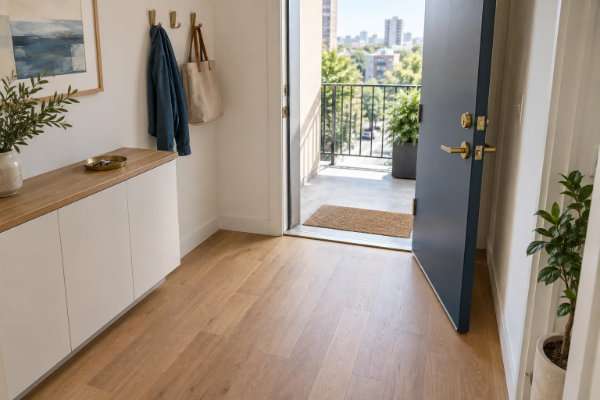
So clear your entrance, open up your passageways, and let the daylight in.
In 1773, the scholar Cao Tingdong, a figure of yǎngshēng, published his Notes on Nourishing Life. He opened his windows every morning and had even a clean room swept. Otherwise, he said, stale air settles in, which harms the Spleen and the Lung. Cao Tingdong recommended airing duvets and pillows in the sun every two or three days.
Invisible influences
There are other influences, harder to perceive because they act beneath our homes. This is the field explored by geobiology. First, there is water flowing underground: underground veins and springs running through the ground beneath our houses.
Geobiology also studies the structure of the ground: geological faults and telluric lines. Finally, it looks at the electric and magnetic fields of our installations: electricity meter, internet router, cables under the bed base.
Geobiologist Stéphane Mazuy reports, for example, that a bed placed above a vein of water leads to light sleep and waking at the same time every night, problems that stop from the very first night spent elsewhere.
The mark a place leaves
A poorly arranged place does not stay neutral: it ends up leaving its mark on those who live there. “Affected by dampness, the head feels as if wrapped,” says the Sù Wèn. Stagnant dampness weighs the body down: a foggy head on waking, heavy limbs, sluggish digestion. TCM sees in this an obstructed Spleen.
Constant shade deprives us of yang: drive is lacking, mood drops, the days drag on. Clutter, for its part, blocks both our movements and the Qi. A cluttered entrance or rooms you no longer walk through can thus create a vague feeling of oppression, or irritability for no apparent reason. As for the arguments that break out in a tense place, TCM links them to the Liver. Anger makes Qi rise, and this rising Qi brings headaches, a stiff neck and broken sleep. Dampness, shade, clutter and tension are therefore not mere matters of comfort: each leaves its mark, and in the end the body speaks.
Paying attention to the layout of your home, and to order and cleanliness, is a way to counter these insidious influences (insidious because they cannot be directly perceived). A few daily habits (see box) let you take care of your home just as you wash in the morning. That in itself is taking care of your health.
Habits for a healthy home
- Space for everyone. The WHO (World Health Organization) links lack of space to stress, to the spread of infections and to broken sleep. In TCM, whatever piles up hinders Qi.
Habit: one room, one function — the bed doesn’t share its space with the desk or with boxes.
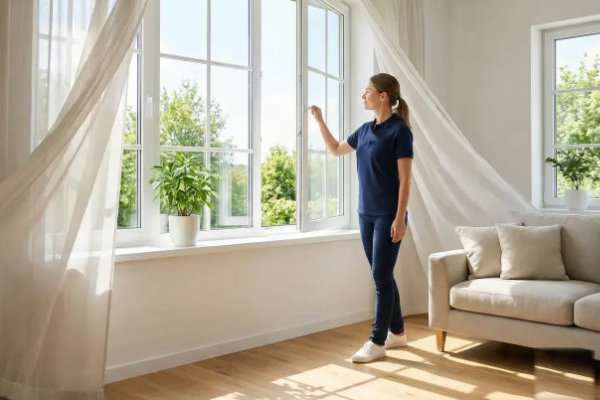
- Air that circulates. Stale air feeds dampness and mould, and the airways pay the price.
Habit: ten minutes with the windows wide open every morning, and the bathroom door left open after a shower to let the moisture out.
- Neither cold nor hot. The WHO recommends at least 18 °C in winter to protect health; extreme cold and heat strain the heart and disturb sleep. In TCM, cold congeals and heat disperses.
Habit: a thermometer in the living room, and the bed away from cold walls as well as from the full midday sun.
- Clean water and clear light. Persistent damp and rooms without daylight are recognised causes of illness.
Habit: track down the stain that keeps coming back, and give your work table the brightest spot.
- A home that doesn’t hurt you. The WHO counts falls and household accidents among the leading housing-related risks.
Habit: clear the passageways, secure slippery rugs, light the way at night — Qi flows wherever your feet move freely.
- Calm for the night. Noise from the neighbours disturbs sleep and raises blood pressure. In TCM, rest requires the Shén to settle.
Habit: in the evening, a dark and quiet bedroom — phone out of the room, curtains drawn.
0 Comments